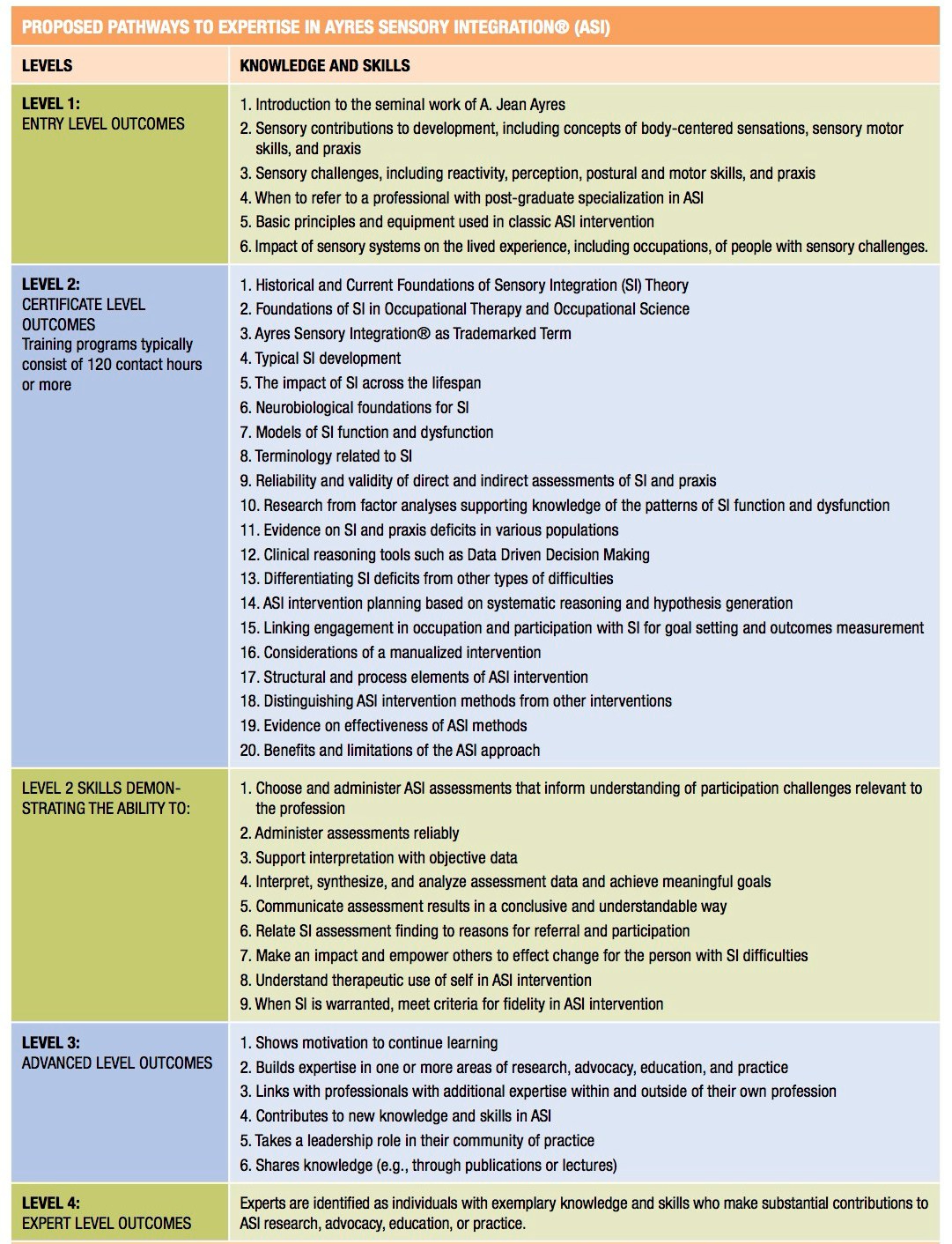
Not all terms used are the same here in the UK, Ireland or abroad. At international meetings, representatives from many international organisations have tried to establish an international standard for education in ASI.
Programmes that meet criteria for ICEASI Level 2 will equate to a therapist having learnt and applied knowledge and skills to assess, interpret and clinically reason to practice – being able to provide and reflect on intervention using the principles of Ayres’ SI.
Our Directors; Amanda Adamson, Kath Smith and Ros Urwin have been meeting up and collaborating with colleagues from across the globe at international conferences and forums. For many years, they have represented ASI education in the UK and Ireland, actively contributing to the development of the learning standards. This global initiative, an international collaboration now called ICEASI was launched at R2K in LA to help build an international group that could support any organisation anywhere in the world develop and offer ASI education that delivers practitioners fit to practice Ayres’ SI.




Completion of ASI WISE’s CLASI CASI modular programme will mean therapists are grounded in, know and understand seminal theory and history of ASI and are aware of and can apply current research and evidence in practice, meeting ICEASI Level 2 criteria.
This will include the ability to understand in detail, use and apply a wide range of assessment tools and methods to clinically reason how to provide intervention to anyone of any age and in any clinical setting; including how to use and interpret the current “gold standard tool” the SIPT (Sensory Integration and Praxis Test), with learning about a new test in development the EASI (Evaluation of Ayres’ Sensory Integration). Read more here.